
It’s not so much that I hated history, or “social studies” in school; I just didn’t give it much thought.
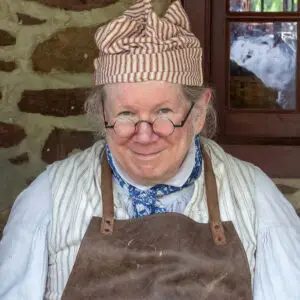
Then I met Denise. She introduced me to the world of re-enacting, the bigger-umbrella term of “Living History.” The bug bit, and stayed bit.
My career as a graphic designer took me from agency freelancing to employment to the gig economy and back again. I honed skills that transition naturally to 18th-Century printing.
The Middle Ages and Renaissance living history, as practiced in the US, has some drawbacks, notably the rarity of venues that feel medieval. My imagination had to work overtime. Meanwhile, I saw video of medieval living history done in Europe, in the exact spot that history took place. True re-enactment. I was jealous! And for a while, I took a breather, and found other things to do.
Once we moved to Pennsylvania — first, a suburb of Philly, and more recently a suburb of Lancaster (if you can call horse-and-buggy country a suburb) — and I felt the historic resonance of the towns, the streets, the fields. The bug bit once again. (Such a shame, too, as I was raised in Westchester County NY, and for a while lived a few blocks away from where Major Andre was captured.)
I find myself caring more about the trajectory of the country, and our need for a reminder of our origin story, warts and all. I see current events through the filter of history. We learn it through the media, then as now.
And ultimately, we’re having fun. We wouldn’t do it if it wasn’t. They even call it “The Hobby.”
Memberships: The .918 Club | New Holland Lions Club | Fifth Pennsylvania Regiment
And then there is me.
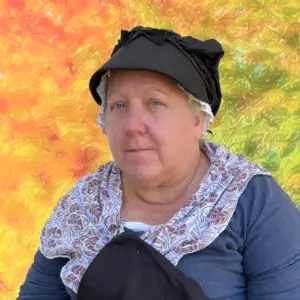 I am strictly a history buff. I became one in junior high when I met a teacher that inspired me to find answers in our past. I have been reenacting for 50 years as of 2026. I, as a young child, traipsed through Colonial Williamsburg, Sturbridge Village, Gettysburg, and many historical houses throughout the Eastern Seaboard. My mother was a history buff and she passed it along to me.
When I started reenacting, I wanted to know the history I would be teaching. I spent my hours poring over books in several libraries and based my reenactments with this research. Today, I have put it all together and after retiring from a long nursing career, I am happily spending my years doing what I have long been interested in. I like to talk about the people around the town, the working people, and how the Revolutionary War both changed their lives and changed history.
Memberships: New Holland Lions Club | Fifth Pennsylvania Regiment
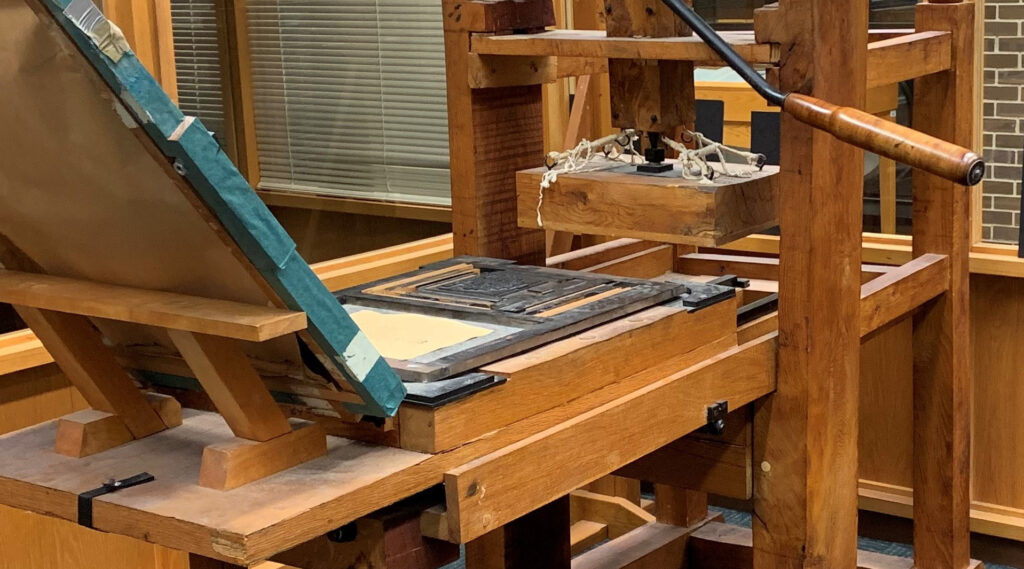
What kind of printing press is it?
How authentic is the ink you use?
What are those things that look like boffers?
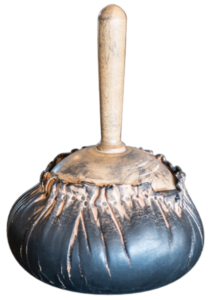 They’re ink balls, also called daubers. Turned pieces of wood, with a circle of leather attached, and stuffed with raw wool. They date back to Gutenberg’s day. They applied an even coat of ink to the type, back before rollers were invented (more precisely, a rubber that could be made into a cylinder).
How in the world do you get all of that into your car?